Today, we are introducing a clearer positioning for Sqilline Health:
Europe’s AI Infrastructure Layer for Oncology.
This is not a new direction. It is a clearer definition of what we have been building over the years — an AI infrastructure and connected oncology ecosystem that transforms fragmented clinical data into trusted, structured and actionable information.
Our goal is to connect hospitals, clinicians, pharmaceutical companies, payers and technology within one European oncology ecosystem — creating value not only from data, but for the organisations and people who generate and use it.
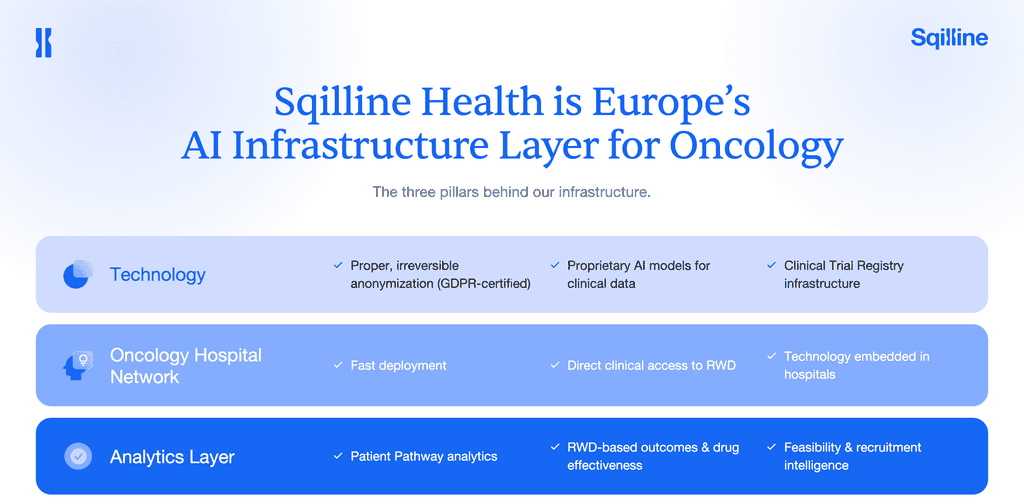
At the centre is the Danny Platform, bringing together three fundamental components of our infrastructure:
Technology — privacy-by-design anonymisation, proprietary AI models that transform unstructured clinical records into structured oncology data, and technology supporting clinical research.
Oncology Hospital Network — technology embedded directly within hospitals, enabling deployment within four weeks, access to real-world oncology data and connection to a growing European oncology ecosystem.
Analytics Layer — turns structured oncology data into powerful insights, providing visibility into patient pathways, treatment patterns, outcomes and drug effectiveness, while enabling real-world evidence generation, clinical trial feasibility and patient recruitment.
Together, these components create a continuous infrastructure from raw clinical data to structured information, evidence and actionable insights.
Creating Value for Hospitals and Clinicians
Our ambition is not simply to structure oncology data. It is to build an ecosystem in which hospitals and clinicians benefit directly from being part of it.
For hospitals, joining the Sqilline Oncology Ecosystem means transforming fragmented clinical information into a strategic asset. Hospitals gain deeper visibility into their patient populations, treatment pathways and outcomes, helping them identify opportunities to improve clinical processes and the quality of oncology care.
Through participation in research, real-world evidence and analytics projects, hospitals can also access additional project-based funding, creating resources that can be reinvested in research, data capabilities and initiatives aimed at improving the quality of services and care for oncology patients.
Being part of the wider ecosystem also creates opportunities for hospitals to participate in multi-centre and cross-country research and evidence-generation initiatives, connecting individual institutions with a broader European oncology network.
For oncologists, the ecosystem makes complex clinical information easier to access and use. Structured patient data can support a better understanding of individual patient histories, identification of relevant patient populations and more informed clinical decision-making.
It also creates opportunities for clinicians to participate in research, real-world evidence generation and scientific collaboration, connecting everyday clinical practice with a growing body of European oncology evidence.
From Infrastructure to a European Oncology Ecosystem
The value of the infrastructure increases as the ecosystem grows.
A single structured patient record can support care. Thousands of consistently structured records can help a hospital understand how cancer is treated in real clinical practice. Millions of records across countries can generate evidence about treatment patterns, outcomes, inequalities and unmet needs across Europe.
Today, Sqilline Health’s AI infrastructure is already deployed across six European countries, supported by 110+ hospital partnerships and 2.7 million+ unique patient records structured into real-world data — creating the foundation for a growing European oncology ecosystem. That same infrastructure now spans 141B+ oncology medical records processed across the network.
Europe’s healthcare systems, languages, clinical practices and data environments differ significantly between countries. Sqilline provides a consistent AI infrastructure layer across this diversity, while preserving the clinical and local context that gives oncology data its meaning.
Sqilline Health’s role is to provide the infrastructure that connects oncology data across hospitals, clinicians, pharmaceutical companies and payers, enabling its use for clinical care, research and real-world evidence.
As this infrastructure expands across Europe, so does the opportunity to generate better evidence, support research and improve the quality of oncology care.